# High Density GameServers
> How to run multiple concurrent game sessions in a single GameServer process.
---
LLMS index: [llms.txt](/site/llms.txt)
---
Depending on the setup and resource requirements of your game server process, sometimes it can be a more economical
use of resources to run multiple concurrent game sessions from within a single `GameServer` instance.
The tradeoff here is that this requires more management on behalf of the integrated game server process and external
systems, since it works around the common Kubernetes and/or Agones container lifecycle.
Here are two different approaches to solving this problem with Agones:
## Session/Room Counters
Warning
The Counters And Lists feature is currently Beta,
and while it is enabled by default it may change in the future.
Use the Feature Gate CountsAndLists to disable this feature.
See the Feature Gate documentation for details on how to disable features.
Utilising the allocation `gameServerState` filter as well as the new ability to add Counter capacity and counts to
`GameServer` records at both [allocation time](/site/docs/reference/gameserverallocation/), and from
within the game server process, [via the SDK][sdk-counter], means Agones is able to atomically track how many sessions
are available on a given a `GameServer` from the list of potentially Ready or Allocated `GameServers` when making an
allocation request.
By also using Counters, we can provide Agones the allocation metadata it needs to pack appropriately across the high
density `GameServer` instances as well.
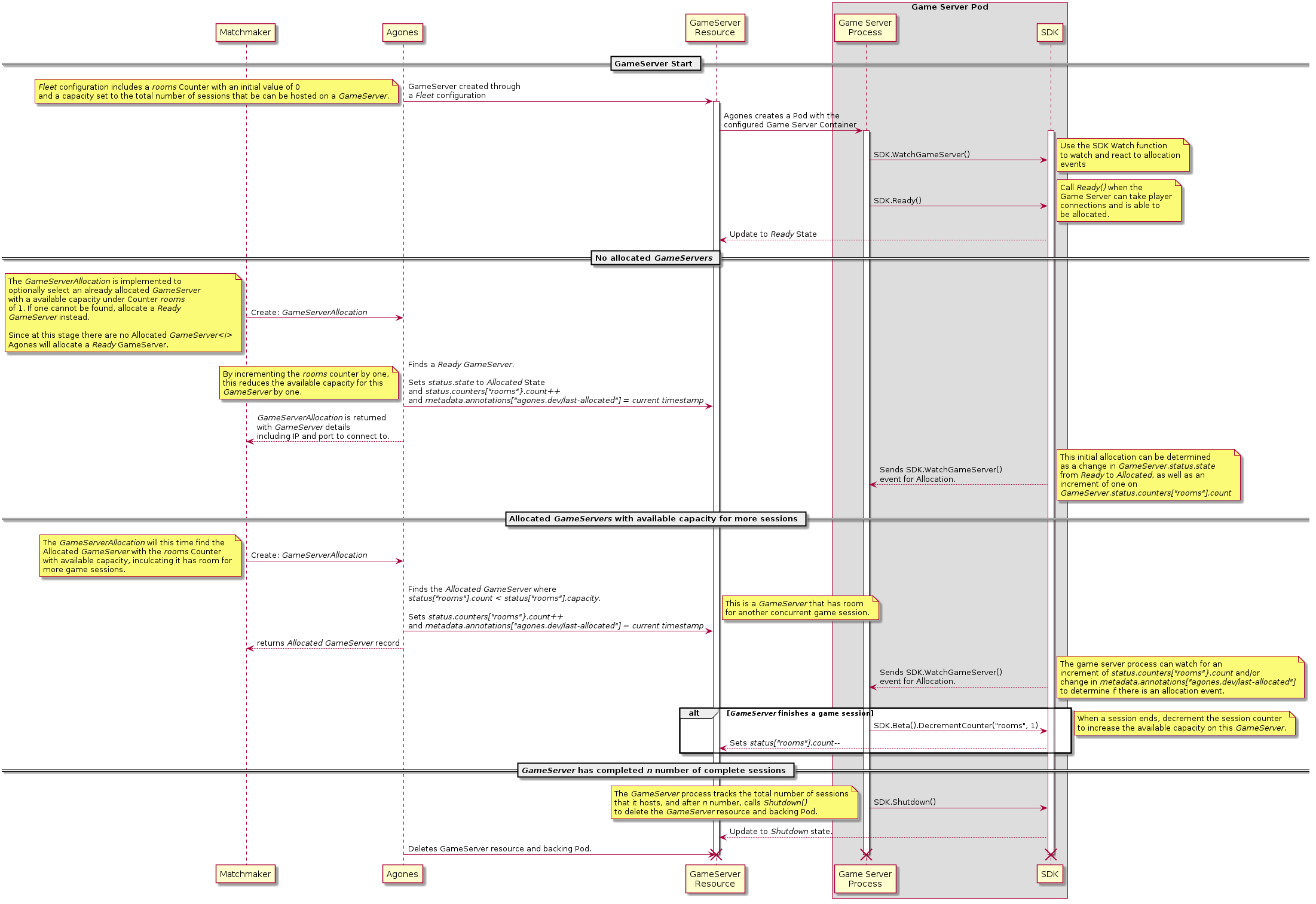 ### Example `GameServerAllocation`
The below `Allocation` will first attempt to find a `GameServer` from the `Fleet` `simple-game-server` that is already
Allocated and also available capacity under the `rooms` Counter.
If an Allocated `GameServer` does not exist with available capacity, then use the next selector to allocate a Ready
`GameServer` from the `simple-game-server` `Fleet`.
Whichever condition is met, once allocation is made against a `GameServer`, the `rooms` Counter will be incremented by
one, thereby decrementing the available capacity of the `room` Counter on the `GameServer` instance. Generally
speaking, once there is no available capacity on the most full `GameServer`, the allocation will prioritise the next
least full `GameServer` to ensure packing across `GameServer` instances.
It will then be up to the game server process to decrement the `rooms` Counter via the SDK when a session comes to end,
to increase the amount of available capacity within the `GameServer` instance.
```yaml
apiVersion: allocation.agones.dev/v1
kind: GameServerAllocation
spec:
scheduling: Packed
priorities:
- type: Counter
key: rooms
order: Ascending # Ensures the "rooms" with the least available capacity (most full rooms) get prioritised.
selectors:
# Check if there is an already Allocated GameServer with room for at least one more session.
- gameServerState: Allocated
matchLabels:
agones.dev/fleet: simple-game-server
counters:
rooms:
minAvailable: 1
# If we can't find an Allocated GameServer, then go get a `Ready` `GameServer`.
- gameServerState: Ready
matchLabels:
agones.dev/fleet: simple-game-server
counters:
rooms:
minAvailable: 1 # not 100% necessary, since our Ready GameServers don't change their count value, but a good practice.
counters:
rooms:
action: Increment
amount: 1 # Bump up the room count by one on Allocation.
```
### Example `GameServerAllocation`
The below `Allocation` will first attempt to find a `GameServer` from the `Fleet` `simple-game-server` that is already
Allocated and also available capacity under the `rooms` Counter.
If an Allocated `GameServer` does not exist with available capacity, then use the next selector to allocate a Ready
`GameServer` from the `simple-game-server` `Fleet`.
Whichever condition is met, once allocation is made against a `GameServer`, the `rooms` Counter will be incremented by
one, thereby decrementing the available capacity of the `room` Counter on the `GameServer` instance. Generally
speaking, once there is no available capacity on the most full `GameServer`, the allocation will prioritise the next
least full `GameServer` to ensure packing across `GameServer` instances.
It will then be up to the game server process to decrement the `rooms` Counter via the SDK when a session comes to end,
to increase the amount of available capacity within the `GameServer` instance.
```yaml
apiVersion: allocation.agones.dev/v1
kind: GameServerAllocation
spec:
scheduling: Packed
priorities:
- type: Counter
key: rooms
order: Ascending # Ensures the "rooms" with the least available capacity (most full rooms) get prioritised.
selectors:
# Check if there is an already Allocated GameServer with room for at least one more session.
- gameServerState: Allocated
matchLabels:
agones.dev/fleet: simple-game-server
counters:
rooms:
minAvailable: 1
# If we can't find an Allocated GameServer, then go get a `Ready` `GameServer`.
- gameServerState: Ready
matchLabels:
agones.dev/fleet: simple-game-server
counters:
rooms:
minAvailable: 1 # not 100% necessary, since our Ready GameServers don't change their count value, but a good practice.
counters:
rooms:
action: Increment
amount: 1 # Bump up the room count by one on Allocation.
```
Note
When using `Packed` `scheduling`, Counter and List `priorities` are used as a tiebreaker within nodes, to ensure packing
across the nodes is done as efficiently as possible first, and the packing within each `GameServer` on the node is done
second.
For a `Distributed` `scheduling` implementation, Counter and List `priorities` are the only sorting that occurs across
the potential set of GameServers that are to be allocated.
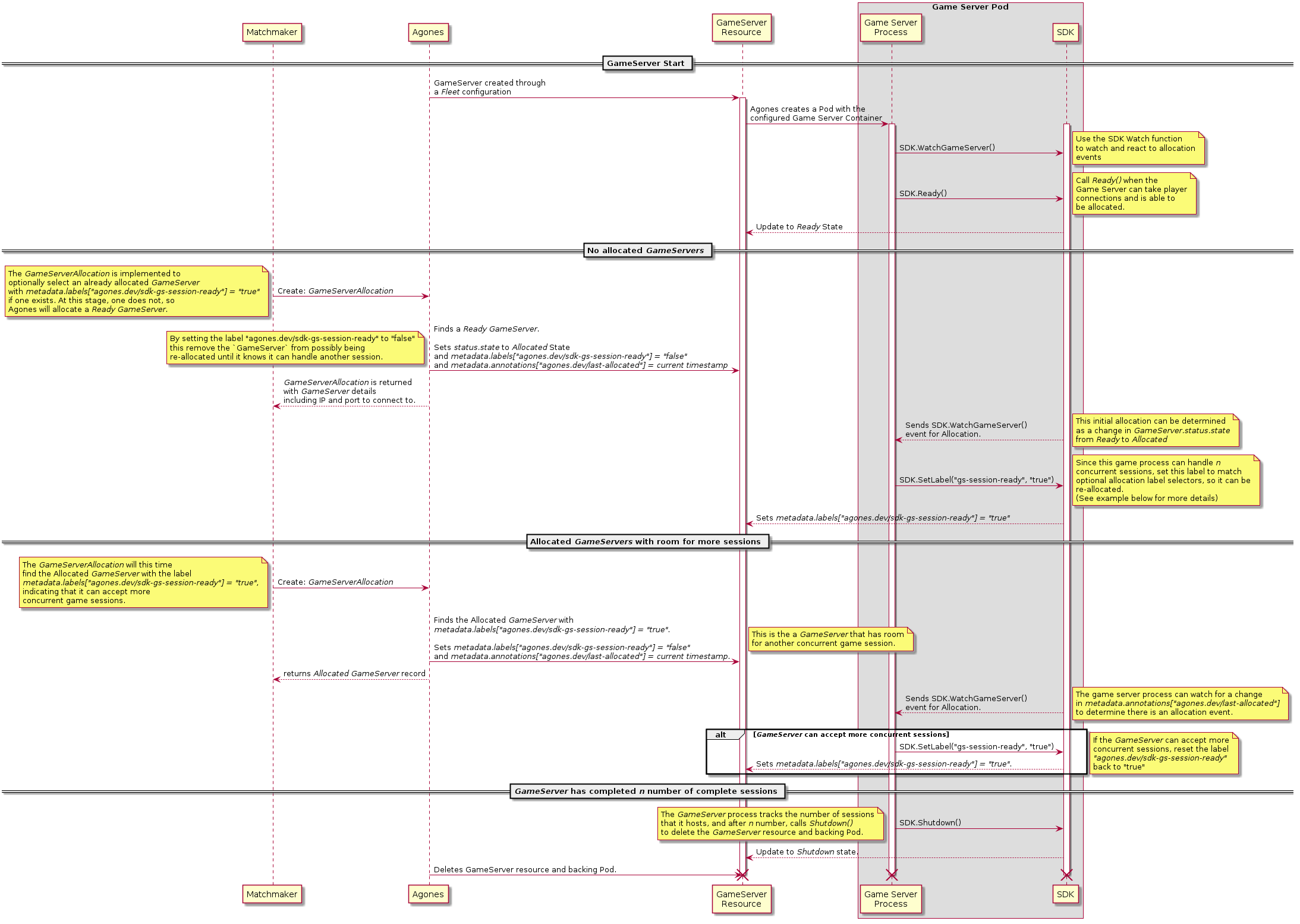
Info
To watch for Allocation events, there is the initial `GameServer.status.state` change from `Ready` to `Allocated`,
but it is also useful to know that the value of `GameServer.metadata.annotations["agones.dev/last-allocated"]` will
change as it is set by Agones with each allocation with the current timestamp, regardless of if there
is a state change or not.
Info
It's important to note that the labels that the `GameServer` process use to add itself back into the pool of
allocatable instances, must start with the prefix `agones.dev/sdk-`, since only labels that have this prefix are
available to be [updated from the SDK](/site/docs/guides/client-sdks/#setlabelkey-value).